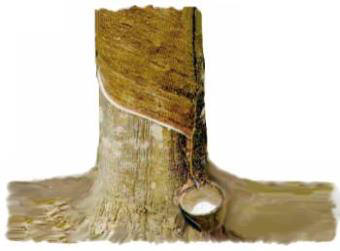
 Rubber Tree Rubber Tree
From the family of Euphorbiaceae is the most common source of
commercial rubber. The latex is collected and is the main ingredient
in making natural rubber. In contrast synthetic rubber is made from
polymers.
Originally, rubber trees grew only in the Amazon region of South
America -rubber trees can grow up to 30 meters high. When
vulcanization was discovered in 1839, demand for rubber increased.
Rubber tree seedlings were exported from Brazil to India in 1873 by
the British to propagate the tree but the rubber tree seedlings did
not survive. But future attempts to export the rubber tree seedlings
to Ceylon, Singapore, Malaya (now Malaysia) were successful and
today, most of the rubber tree plantations are in Southeast Asia,
Central America and Africa.
Harvesting of rubber latex:
Rubber trees that are 5 years old or more produce a whitish or
yellowish latex that can be harvested by cutting into the bark with
a herringbone pattern, deep enough to reach the latex vessels but
before the phloem -the hard wood. The older the rubber tree gets,
the more latex is produced.
Processing of the latex:
After collecting the latex into small containers, the latex is
heated and smoked by burning wood, stirred and then acid or alkali
is added to coagulate or thicken the latex, then it is pressed to
remove water. The resultant flat "cakes" are hung to dry. After
drying, it is ready to be shipped to factories and made into various
types of rubber products.
Rubber Industry in the Philippines:
Rubber tree seedlings was introduced in the Philippines by the Menzi
Agricultural Corporation in 1905 in Basilan. Almost at the same time
as Indonesia & Malaysia started their rubber industry. Several years
later, plantations were established in Cotabato and Zamboanga del
Sur (in addition to the plantation in Basialn). Today these
provinces are still the major producers of rubber in the Philippines
-but only about 100,000 hectares of land is planted with rubber
trees. Compared to the Philippines' neighbors, the Philippines lags
behind in rubber production. The recent and continuing rise of
rubber demand and prices in the world market, just might awaken the
Philippine rubber industry to see the opportunity for a brighter
future for the industry...
|